How was SuperTech evaluated in an academic laboratory setting?
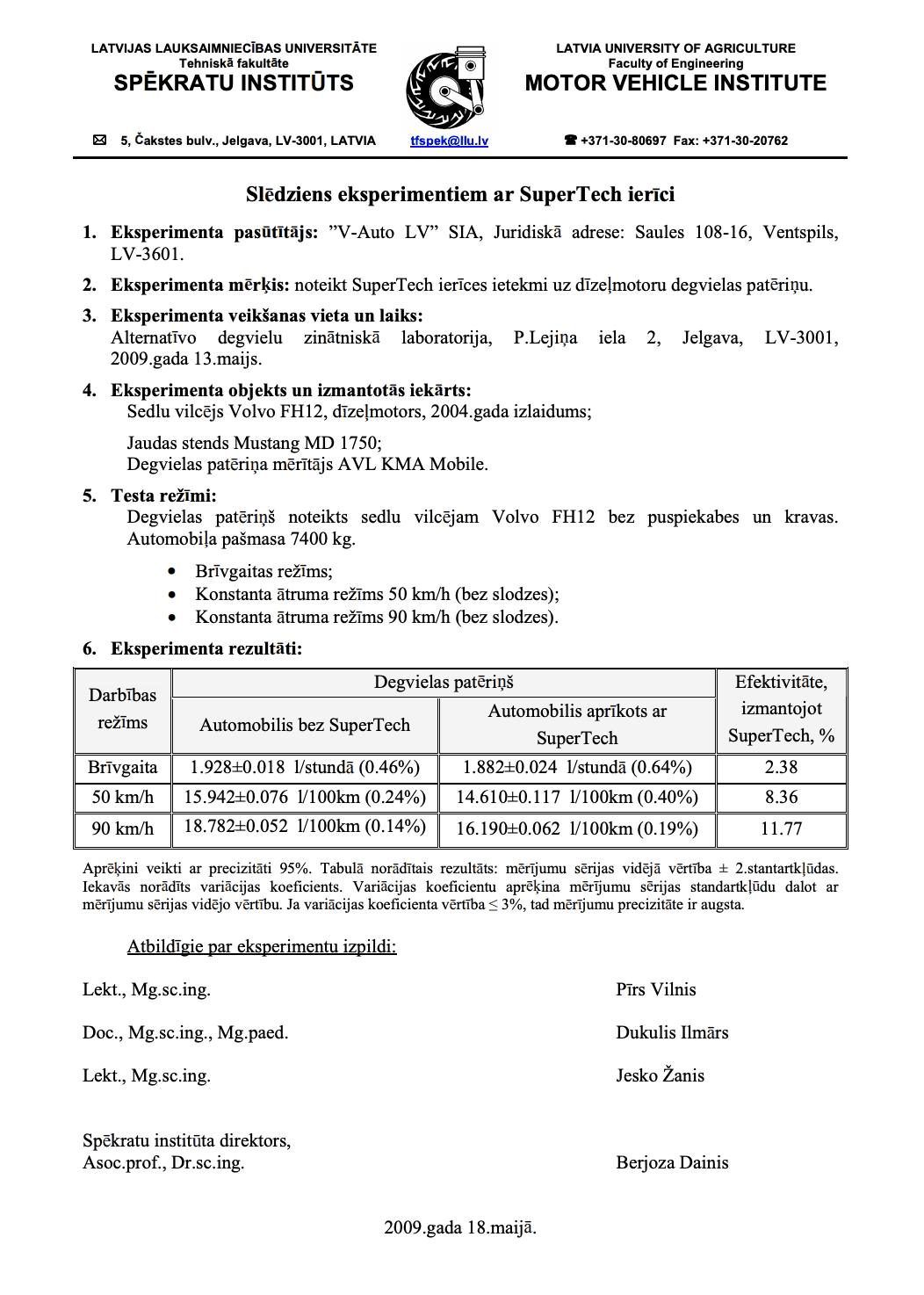
The Latvia University of Agriculture (LLU), Faculty of Engineering, Motor Vehicle Institute, conducted a controlled laboratory evaluation to assess the influence of SuperTech® on diesel fuel consumption under defined operating conditions.
The evaluation was carried out within the Scientific Laboratory of Alternative Fuels in Jelgava, Latvia, using a single heavy-duty vehicle and repeatable test procedures.
Evaluation Scope & Method
The evaluation focused on measuring fuel consumption differences with and without SuperTech® installed, under controlled conditions on a chassis dynamometer.
All tests were conducted using the same vehicle, under identical operating parameters, with no changes made to engine configuration, calibration, or vehicle systems between test runs.
Which equipment and measurement standards were used?
Fuel consumption measurements were conducted using AVL-certified fuel measurement systems, in conjunction with a Mustang MD 1750 chassis dynamometer.
Reported values are presented as mean measurements with defined error margins, reflecting a 95% confidence level, consistent with standard laboratory practice.
What operating conditions were evaluated?
Fuel consumption was measured under the following conditions:
Idle operation
Constant speed at 50 km/h (no load)
Constant speed at 90 km/h (no load)
Each condition was tested with and without SuperTech installed, allowing direct comparison under identical conditions.
What were the observed results?
Measured fuel consumption values showed reductions across all evaluated conditions when SuperTech® was installed:
Idle: approximately 2.4% reduction
50 km/h: approximately 8.4% reduction
90 km/h: approximately 11.8% reduction
Measurement variability remained low, with coefficients of variation below 3%, indicating consistent test results.
What is the takeaway for engineers and researchers?
The Latvia University of Agriculture evaluation demonstrates that controlled laboratory testing can be used to quantify fuel consumption differences under defined operating conditions, without modifying engine systems or vehicle configuration.
This reference documents measured outcomes under specific laboratory conditions using a single vehicle. It does not constitute a regulatory certification or guarantee of results. Outcomes may vary depending on vehicle type, configuration, and real-world duty cycle.