How was SuperTech evaluated by the Institute of Transport Technologies?
The Dnepropetrovsk National University of Railway Transport, through its Institute of Transport Technologies, conducted controlled laboratory testing to evaluate the influence of SuperTech® on vehicle emissions and fuel economy.
The evaluation was performed using certified test equipment under repeatable conditions, with before-and-after measurements taken on multiple vehicles.
Evaluation Scope & Method
Testing was carried out using a Ricardo chassis dynamometer, with vehicles secured and operated under controlled speed, load, and temperature conditions.
Two evaluation programs were conducted:
Exhaust emissions testing
Fuel economy and mileage testing
All measurements were performed using the same vehicles, equipment, and test parameters before and after installation. No engine tuning or system modifications were made during testing.
What were the observed emissions results?
According to the documented test results:
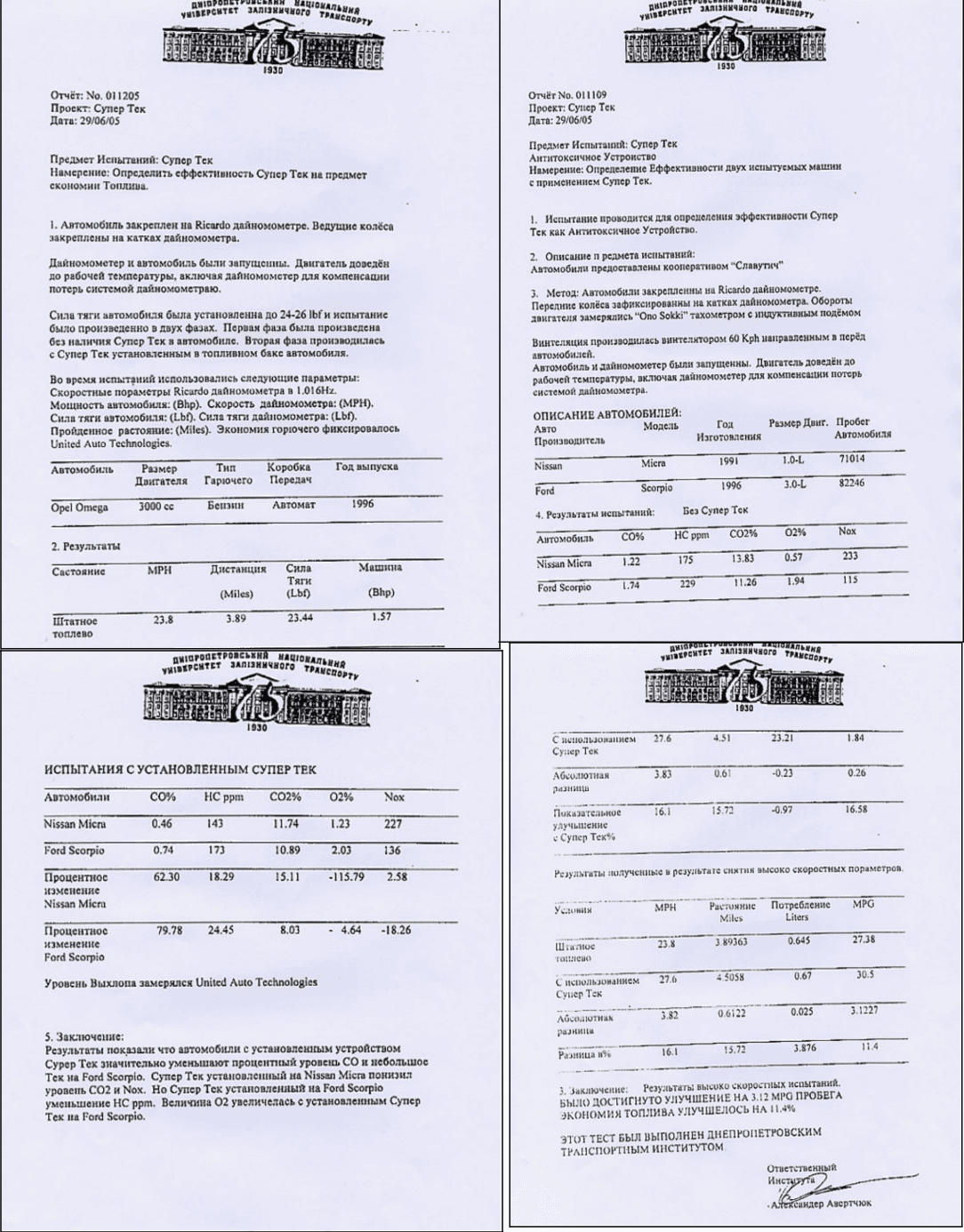
Carbon monoxide (CO) emissions were reduced by approximately 62–80%, depending on vehicle and operating condition
Hydrocarbon (HC) emissions were reduced by approximately 18–24%
Carbon dioxide (CO₂) levels showed reductions of approximately 8–15%
Nitrogen oxides (NOx) varied by vehicle and test phase
The report notes that results varied by vehicle configuration and operating regime, which is typical in controlled engine testing.
What were the observed fuel economy results?
In high-speed fuel economy testing:
Mileage increased by approximately 3.12 MPG
Overall fuel economy improved by approximately 11.4%
Improvements were recorded under identical speed and load conditions
What is the takeaway for engineers and fleet operators?
The Dnepropetrovsk Institute evaluation demonstrates that controlled laboratory testing can document both emissions reductions and fuel economy improvements without modifying engine systems.
This reference documents measured outcomes under specific laboratory conditions. It does not constitute a regulatory certification or guarantee of results. Outcomes may vary depending on vehicle type, operating conditions, and duty cycle.