How did the Government of Chile evaluate SuperTech®?
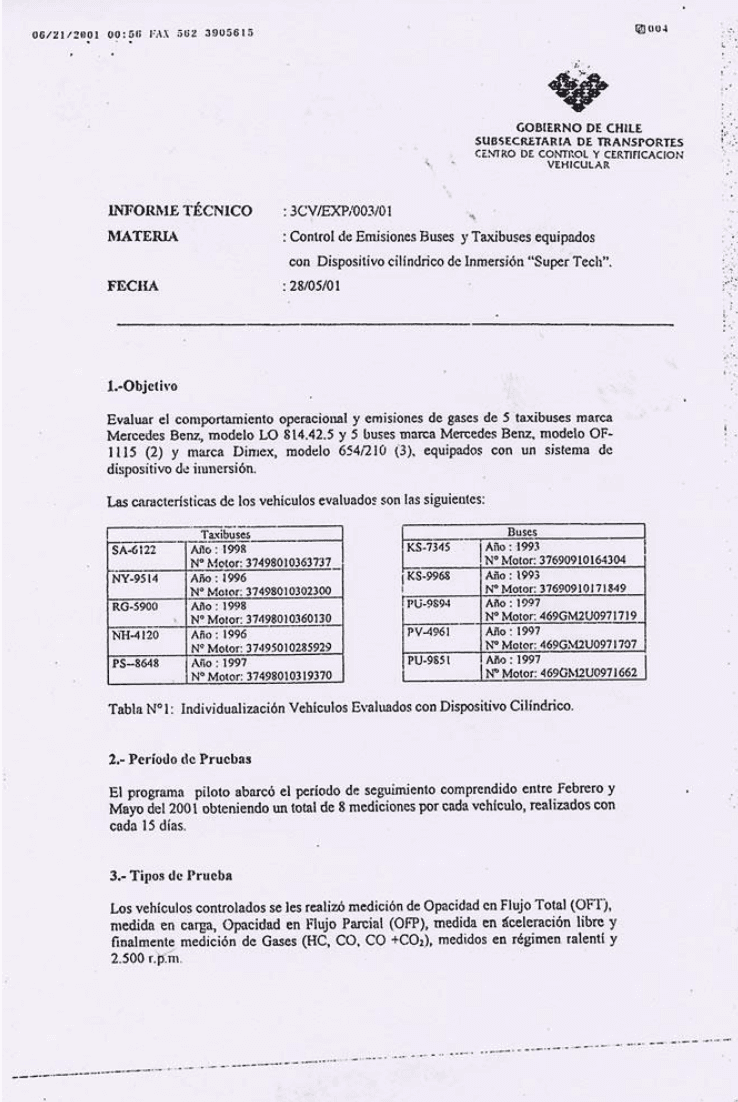
The Government of Chile, through the Undersecretariat of Transport and the Vehicular Control and Certification Center, conducted an official pilot evaluation program to assess the impact of the SuperTech® immersion device on exhaust emissions in public transport vehicles.
The evaluation formed part of a government-supervised emissions control program and focused on measuring changes in hydrocarbon (HC) emissions and exhaust behavior under controlled inspection conditions.
Evaluation Scope & Method
According to the official technical report 3CV/EXP/003/01, the evaluation included:
Public transport vehicles, including:
5 diesel buses
5 diesel taxibuses
Vehicles equipped with SuperTech® immersion devices
Testing conducted between February and May 2001
Eight emissions measurements per vehicle, conducted approximately every 15 days
Emissions measured included:
Hydrocarbons (HC)
Carbon monoxide (CO)
Carbon dioxide (CO₂)
Measurements performed at:
Idle
Partial flow
Free acceleration
Steady-state engine speeds (up to ~2,500 rpm)
Testing conducted by the Vehicular Control and Certification Center, the official authority responsible for emissions compliance
No engine modifications, tuning, or changes to vehicle systems were introduced during the evaluation.
What were the observed results following installation?
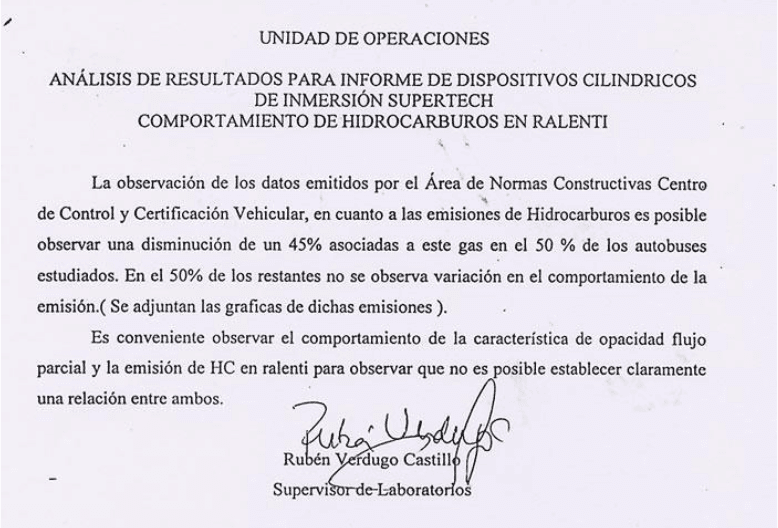
Based on the official laboratory analysis issued by the Government of Chile:
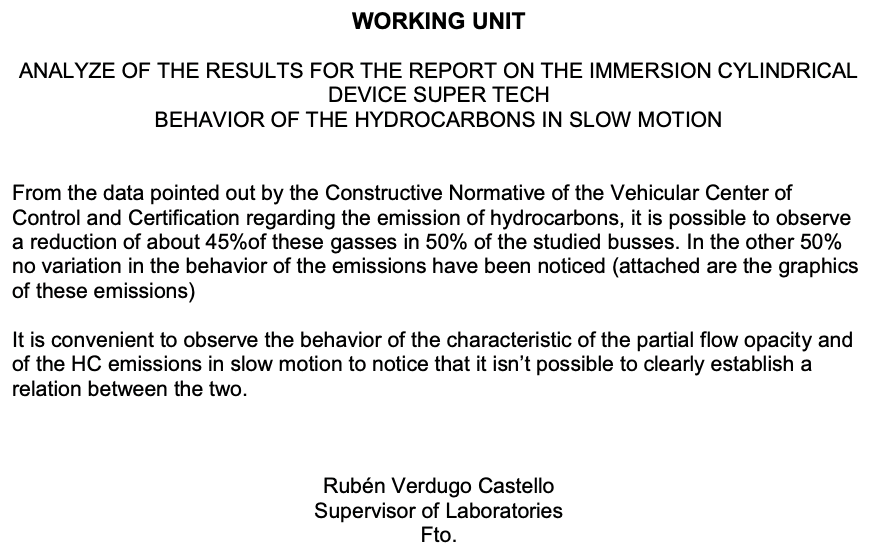
Hydrocarbon (HC) emissions were reduced by approximately 45% in 50% of the evaluated buses
The remaining vehicles showed no measurable deterioration in hydrocarbon emissions
The evaluation confirmed that SuperTech® did not negatively affect exhaust opacity or emissions stability
Variations between vehicles were attributed to differences in baseline condition, which is typical in real-world fleet testing
The findings were formally reviewed and signed by the Supervisor of Laboratories at the Vehicular Control and Certification Center.
What is the key takeaway for regulators and fleet operators?
The Government of Chile's pilot program demonstrates that government-supervised emissions testing can document meaningful reductions in regulated exhaust hydrocarbons when upstream, in-tank fuel-conditioning technologies are applied to public transport fleets.
This reference documents observed outcomes under specific test conditions and does not constitute a regulatory certification or guarantee of results. Performance may vary depending on vehicle condition, maintenance practices, fuel quality, and duty cycle.